
For construction
Who is on your site right now?
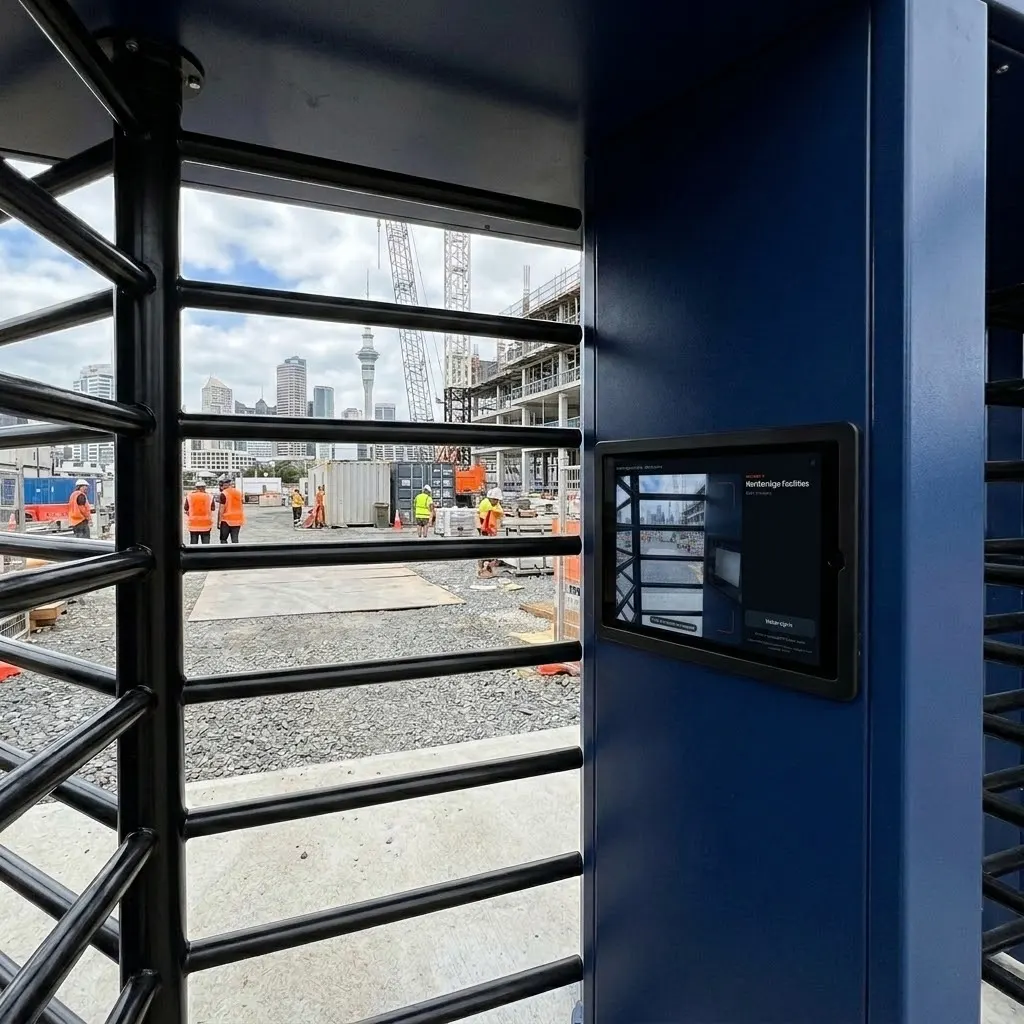
If the alarm went at eleven this morning, how long would it take to answer that and how confident would you be? iENTR turns an iPad at the gate into a touchless sign-in that works in gloves, in rain and with no signal and gives you a live head count you can hand to a fire warden.
From NZD $49 a month per site. No installer, no turnstile, no quote.
What the law actually says and what it does not
There is no statute in New Zealand, Australia or the United Kingdom that says "keep a site sign-in register." Anyone telling you otherwise is selling something. What the law does require is more useful to know, because it is the thing you will be asked to evidence.
Australia.
WHS Regulation 298 requires a person with management or control of a workplace at which construction work is carried out to ensure, so far as is reasonably practicable, that the workplace is secured from unauthorised access. It is a strict liability provision.
United Kingdom.
CDM Regulations 2015 regulation 13(4) requires the principal contractor to ensure a suitable site induction is provided and that the necessary steps are taken to prevent access by unauthorised persons. Regulation 15(10) applies the same duty to every contractor.
New Zealand.
HSWA 2015 section 37 requires a PCBU managing a workplace to ensure the workplace and the means of entering and exiting it are without health and safety risks to any person. The General Risk and Workplace Management Regulations 2016 regulation 14 requires an emergency plan that includes evacuation procedures and effective communication between the person coordinating the emergency response and all other persons at the workplace.
Read that last clause again. You cannot communicate effectively with people you cannot enumerate. The law sets the outcome. A sign-in record is simply the cheapest way to prove you met it.
Why paper and pins fail on a real site
A clipboard is a record of who intended to sign in.
It is not a record of who is present. Everyone in construction knows this and everyone has been in the toolbox talk where it was raised again.
Cards get shared, lost and left in the ute.
A card proves a card was present.
PINs need a bare finger.
In July, in the rain, at the gate, with a load coming through behind you, they do not get used.
Turnstiles solve it and cost like it.
A turnstile is a good answer with a bad invoice: a capital purchase, a slab, a power run and a fixed position on a site that will not be the same shape in six weeks.
What iENTR does
Touchless, so it actually gets used.
A glance from two metres, in gloves, with a hard hat on, in under a second. Adoption is the whole ballgame in site sign-in and every second of friction is a person who walks past.
It works with no signal.
Recognition runs from the device's local cache and the door keeps releasing. Records queue and sync when coverage returns. On a rural or basement site this is the difference between a system and a doorstop.
A live head count, on your phone.
Who is on site, at this second, by subcontractor. Export it, or hand the phone to the fire warden.
Timesheets that build themselves.
Every gate entry and exit is verified by the worker's own face, so timesheets are generated automatically from the record and exported whenever payroll wants them. Nobody clocks in a mate, nobody rounds up an afternoon and nobody keys a week of hours from memory.
Induction status at the gate.
Enrolment can carry induction and ticket expiry, so a person whose ConstructSafe or Site Safe currency has lapsed is flagged at the point they arrive rather than discovered in an audit.
It moves when the site moves.
Unmount the iPad, mount it at the new gate. No slab, no electrician, no reinstatement.
"The boys will not go for it"
They will not, if you require it. So do not.
Every iENTR site can run card, PIN or QR alongside faces, with identical features. Nobody is required to enrol. This is not a concession, it is the correct design and there is a case behind it: in 2024 the UK Information Commissioner ordered a leisure operator to stop using facial recognition for staff attendance across 38 sites, partly because enrolment had been presented as a requirement in order to get paid, so consent was not genuine.
In practice, on a site where faces are optional, adoption climbs anyway, because the people who tried it stop queueing.
What it costs, in site terms
One site, forty workers, two scans each per day, twenty-two working days: about 1,760 scans a month. That is $49 plus roughly $18, so under $70 a month.
Five sites on Growth: $249 plus usage.
Compare that against a single turnstile installation and then against the fact that the turnstile cannot follow the job.
Seven days. One gate. Judge it yourself.