
For gyms and fitness
One membership. One person.
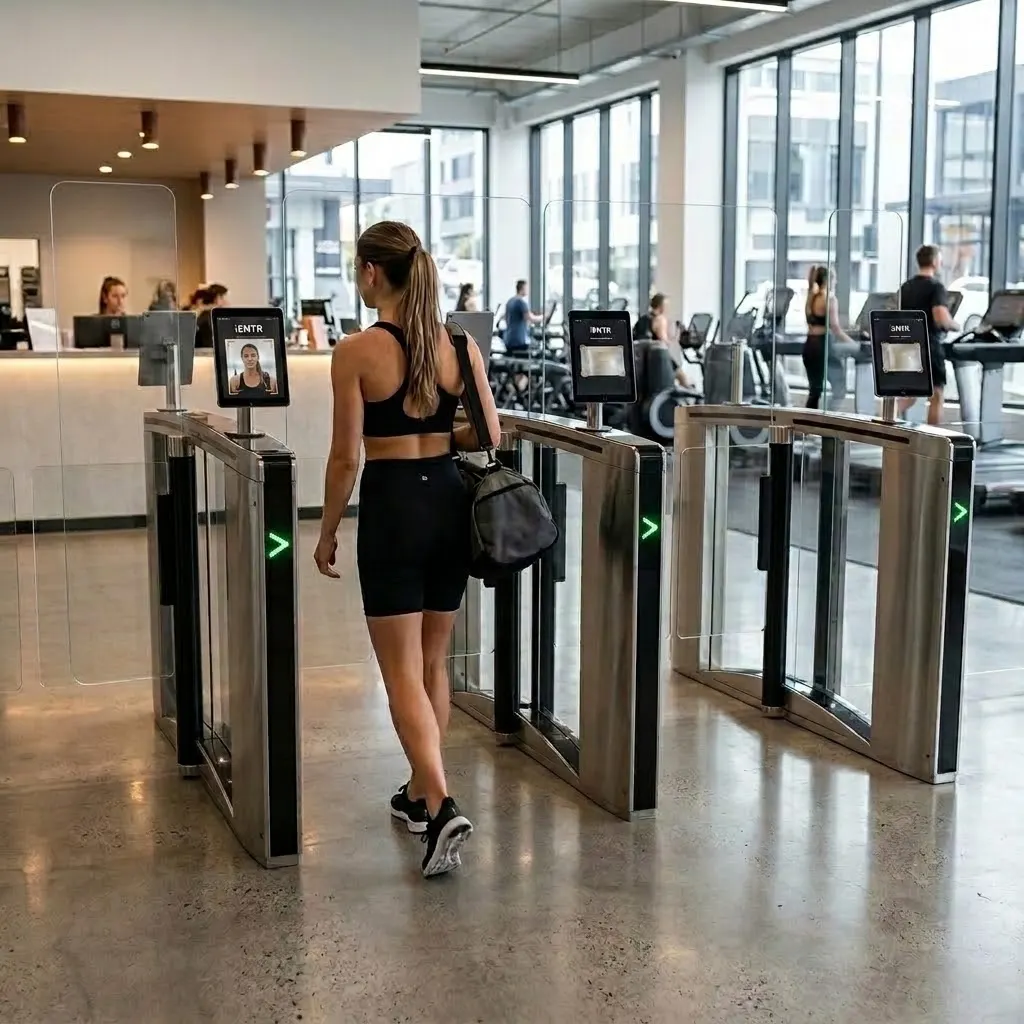
Cards get shared. Fobs get lent. Codes get passed around the flat. A face cannot be handed to a mate at the door and it cannot be left at home. iENTR turns an iPad at your entry into touchless, one-person-per-membership access and tells you who is inside during unstaffed hours.
From NZD $49 a month per club.
The honest version
No law requires a gym to record who walks in. We are not going to pretend otherwise. Two things do apply and both are real.
Your duty of care.
Under HSWA 2015 in New Zealand and the WHS Act in Australia you must ensure people at your facility are not put at risk and your emergency plan must let you communicate with everyone present. During unstaffed hours you cannot do either without knowing who is in the building.
Your industry's own guidance.
Exercise New Zealand's guidance for operating unsupervised exercise facilities asks operators directly: "what system do you have to pick up if more than one person enters on the same membership? i.e. illegal entry" and states that any access system "needs to be extremely robust and reliable for declining access to unauthorised users." AUSactive's recommendations for unsupervised facilities call for electronic monitoring of all entry and exit points.
Note what the industry body is doing there. It is treating multiple entries on one membership as a safety issue, not just a revenue one. It is both.
What card sharing actually costs you
We are deliberately not quoting a percentage. Every figure circulating on this subject traces back to an access control vendor's blog with no methodology behind it and you should be suspicious of anyone who hands you one.
Run your own number instead, because it takes ten minutes and it is the only one that will convince you.
- Take your 24/7 door swipes for last month.
- Count how many memberships recorded two entries within a few minutes of each other.
- Multiply by your monthly fee.
That figure is yours, it is defensible and in most clubs it is larger than the cost of fixing it.
What iENTR does
One membership, one face.
A face cannot be lent, forwarded, screenshotted or left in a gym bag.
Tailgating you can see.
Entries are logged per person, so two people through one door on one credential shows up as what it is, in the record, the same day.
Touchless at 5am in winter.
No fob to find in a jacket pocket, no code with wet hands. In practice this is what members actually notice and mention.
Live occupancy during unstaffed hours.
Who is in the building, right now, on your phone. If a panic alarm sounds at 4:40am, you know who to look for and so do the people responding.
Instant revocation.
A cancelled membership stops working the moment you cancel it, not when a fob is eventually returned.
It moves with your fitout.
No turnstile, no slab, no cabling.
"But we already have GymMaster"
Good, it is excellent and iENTR is not trying to replace it. GymMaster runs your memberships, your billing and your bookings. iENTR runs your door. If you are on GymMaster's built-in Bluetooth access and it is working for you, you may not need us.
Where iENTR is worth a look is the specific problem Bluetooth and fobs cannot solve: credential sharing. A phone can be handed over at the door exactly as easily as a fob. A face cannot.
And if you are currently being quoted for facial recognition turnstiles, get a price on those and then run a seven-day iENTR trial on the same door before you sign. New Zealand's largest chain is mid-rollout of exactly that hardware, so the quotes are out there and the comparison is worth an afternoon.
"Will members find it creepy?"
Some will, so do not make it compulsory. Members who prefer a fob or a PIN keep one, with identical access.
For the ones who ask, the answers are short. The template is created and matched on the iPad at your club and syncs only to the terminals you have paired. iENTR verifies one person against their own membership. It does not identify strangers, never scans anyone who is not a member against any list and infers nothing about age, gender, mood or health. Every member can be deleted on request and the purge actually runs.
What it costs
A 24/7 club with 400 members averaging eight visits a month: about 6,400 scans, so $49 plus roughly $64, around $113 a month.
Set that beside one shared membership recovered.
Seven days. One door. Watch what shows up in the log.