
For early childhood and schools
Verify the adult at the door.
iENTR does not enrol children. It verifies the grown-ups: staff, parents, caregivers, authorised nominees, relievers and contractors. Sign-in and sign-out are written automatically, with the person who signed recorded every time.
From NZD $49 a month per centre.
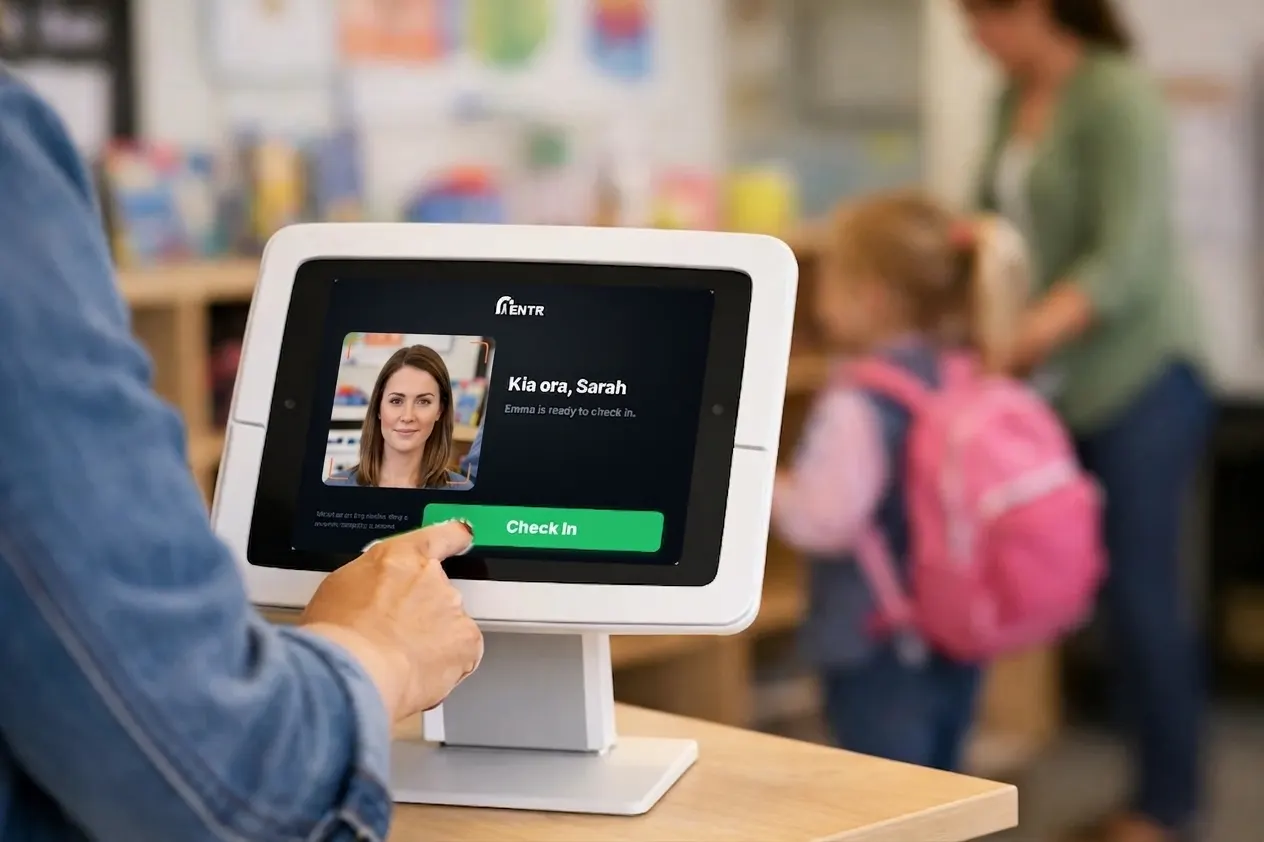
Children are not enrolled. That is a design decision.
We are leading with this because it is the question you were going to ask third and because the answer changes the conversation.
Facial recognition on children is the most heavily regulated application of this technology anywhere. In England and Wales the Protection of Freedoms Act 2012 requires written parental notification and consent before a school processes a child's biometric information, gives the child an absolute veto regardless of parental consent and requires that reasonable alternative means are always available. In 2024 the Information Commissioner reprimanded a school over facial recognition for canteen payments, finding among other things that "the law does not deem 'opt out' a valid form of consent." In New Zealand, the Biometric Processing Privacy Code 2025 applies heightened scrutiny to children's biometrics and the Privacy Act's fourth principle carries express protections for children and young people.
iENTR sidesteps all of it, because the thing your regulator, your licensing criteria and your parents actually care about is which adult took the child.
What is actually required of you
Australia.
Under the Education and Care Services National Regulations, regulation 158 requires an attendance record recording each child's full name, the date and time each child arrives and departs and the signature of the person who delivers or collects them, or of a nominated supervisor or educator. Regulation 99 permits a child to be taken from the premises only into the care of a parent, an authorised nominee named in the enrolment record, or a person authorised by them. This is the only "time in, time out, who signed" requirement written in black letter anywhere in this market.
New Zealand.
Licensing criterion GMA109 requires enrolment and attendance records for every child, kept for seven years, meeting the ECE Funding Handbook. The Handbook requires days and times of actual attendance and evidence, such as a signed attendance register, that a parent or guardian has regularly examined and confirmed the record: weekly for all-day and home-based services. Attendance claimed incorrectly is recovered by the Ministry on audit.
New Zealand, staff.
Children's workers must be safety checked under the Children's Act 2014, including confirmation of identity, with a re-check every three years.
United Kingdom.
Keeping Children Safe in Education 2025 requires a single central record showing, with dates, an identity check for all staff including agency and supply staff working even one day and says schools should check ID for visitors attending in a professional capacity.
Why the paper book fails and it is not the reason you think
It is not that parents will not sign. It is that the sign-in book records a signature and what you will be asked for later is an identity. A signature in a book does not tell an auditor, or a distressed parent, or a Ministry reviewer, which specific adult was standing at that door at 3:42pm. It tells them a name was written.
The second failure is quieter and more expensive. Attendance recorded from memory at the end of a session is attendance recorded approximately and in New Zealand approximate attendance is a funding recovery risk.
What iENTR does
Verifies the adult, writes the record.
Parent, caregiver, nominee, staff member, reliever or contractor, matched in under a second, with the time and direction written automatically.
Authorised collection, enforced at the door.
Only adults on that child's authorised list are recognised for collection. An unrecognised adult is flagged to a staff device before anything happens.
Contractor and reliever identity.
A reliever's identity is verified at arrival and their record sits alongside your safety-checking file.
An accurate attendance export.
Times of actual arrival and departure, exportable in the shape your funding return needs.
Evacuation.
Live occupancy on a staff phone, which is exactly what your Fire and Emergency approved evacuation scheme requires you to be able to report on. Early childhood services must trial evacuate at least every six months, so this will be exercised.
"Will parents object?"
Some will and they are entitled to. Here is what you can tell them and all of it is true.
Children are not enrolled. Only adults are and only adults who choose to be. Any parent can decline and use a PIN or QR instead, with no difference in service. The face template is created and matched on the iPad in the centre and syncs only to the terminals you have paired. iENTR never scans strangers against any list and does not infer age, mood, health or ethnicity. And iENTR provides you with the notification and proportionality assessment templates, so parents can read exactly the same explanation you did.
The centres where this goes well are the ones that publish the assessment before anyone asks.
What it costs
One centre, 60 families and 12 staff, two scans each per weekday: roughly 3,100 scans a month, so $49 plus about $31, around $80 a month.
Seven days free. One door. Live in half an hour.